Wednesday, October 2, 2019

Weeding between the lines

By Jim McGinty


End of the 2019 gardening season, and many seasoned gardeners are sighing in relief:  we experienced another “challenging” year with unreliable weather forecasts, on again and off again Summer heat, and then unbelievable September rains.

On the other hand, we also saw spectacular fruit tree harvests, especially apples and plums, and the berry crops were amazing, so maybe on balance, not too bad a year.

Here at Rancho McGinty, my gardening partner and longtime wife Pat, and I learned some new gardening tips and techniques:  shade cloth over new transplants is a great idea – we improvised with shear curtains from the thrift stores, and we saw much better recovery and long term growth from baby veggies; growing onions through black plastic film produces really large and juicy bulbs – I used my plumber’s propane torch to burn three inch diameter holes through salvaged four mil black polyfilm as a low-cost alternative to purchased commercial strips.  I was so happy with this year’s harvest results, that I just bought a commercial roll of twenty-four inch wide by twenty-five foot black plastic film, complete with four inch holes already in place; using empty and upended recycled small plastic water bottles over the ends of upright rebar (used to hold fabrics up and over delicate or frost-sensitive plants) precludes wear and tear holes in that fabric;  and positioning floating row cover over squash and pumpkin plants really raises the temperature underneath the “Ree-May ®” or “Agribond ®” fabric, and the almost-ripe fruit has a significant chance to mature, especially when frost is only weeks away.

Out in the garden, now is the time to finish planting garlic – I’m trying a new to me garlic variety, named “Doukhobor”, which claims to have “intense heat” – the “Georgia Fire” variety I already grow has a sweat-raising reputation, so we’ll see.

Now is NOT the time to fertilize fruit trees and bushes, as the nitrogen hit will encourage a flush of tender leaves, causing Winter distress to the plants. However, now IS the time to soak those trees and bushes with water, keeping months-long dehydration at bay.

This is the time to cut out those brown raspberry canes, the ones that bore fruit this year – be sure to leave the purple or green canes that will bear fruit next year – I prefer to burn the brown canes, as they sometimes contain the eggs of next Summer’s cane borers.

Now is the time to start one more compost bin on it’s way to usefulness in Spring 2020:  lots of leaves and grass clippings are available, as well as field straw, and livestock poo – a little time spent now will create brown earthy goodness for planting time next season.

Gardening resolutions for the 2020 season here at Rancho McGinty:  start seeds indoors two weeks earlier – we had gaps in the planting/harvesting timeframes (open dirt, no available transplants); plant baby veggies outside much sooner than we did this year – we need to push our luck if we want more ripe veggies; buy seeds now – some of our favorite varieties were not available, or at least not when we needed them; and use more heavy duty weed fabric to reduce the  “where did all those weeds come from?!” moments – our time in the garden (and here on Earth) is precious.

GARDEN CALENDAR:

On October 8th, our local garden club will hold it’s last 2019 meeting, AND annual Harvest Dinner at 7 P.M., in Camden Grange.  We will dine on cooked meat (potentially automotively-processed, but I’ll see what the road side inventory looks like), side dishes prepared with produce from the gardens and orchards of our club members, and desserts, etc.  If you will be attending, please let me know how many of “you” there are, and what you will be bringing.  This particular meeting is also the time to bring your cherished Garden Club Garden Gnome, if you are one of the lucky few – the stature-challenged guys hold their annual Gnome Conclave on the same evening.

You can discover additional details on the Harvest Dinner by checking our club’s website, www.elk-camdengardenkeepers.blogspot.com, or by looking at our Facebook group page. 

On the 10th of October, those fabulous flora facilitators, the Master Gardeners of Pend Oreille County will offer a class on “Gardening with Wildlife”.  I initially thought the class would show us gardeners how to benefit from the remains of all those veggie and fruit marauders (raccoons, deer, turkeys – despoilers all!), but no, the class instructors, Carol Mack and John Stuart tell me that their two hour session from 6:30 P.M. to 8:30 P.M. will focus on “coexisting with our feathered and furry friends”.  The class will be held in the Pend Oreille County/W.S.U. Extension Office, located at 227 South Garden Avenue, Newport, and you may register for the $5 class by calling 509-447-2401.

That’s it for this year – enjoy your Winter, and I’ll see you in March 2020.


Sunday, September 22, 2019

August tour was berry wonderful

Way back on the 13th of August, we visited Vista Haven farms in Elk, with a crowd of 42 avid gardeners and a few nosy neighbors. 

https://drive.google.com/uc?export=view&id=1aURU4SgLilIuhNPei4d6l_2Nvuu467fK

https://drive.google.com/uc?export=view&id=1weCqxzk1sJp5K56v1_kuYUoyoVuxURME
Kim and Chris McCay guided us around an amazing farm, complete with berry gardens, asparagus fields, tree fruit orchard, huge compost operations, and on-going projects for salad greens production, and cut-flower raised beds.  We tasted wonderful blackberries, and learned of plans for future improvements and direct sales to the public, local farmers' markets, and restaurants.

Oh, and we asked about a million questions of Kim and Chris, and their answers are summarized as follows:  blueberry soil amendments used are "Down to Earth" acid mix in Autumn to acidify the local sandy soil, "Espoma" acid mix in the Spring to continue the acidification process, and "Espoma" holly-tone fertilizer to feed the plants.  During the Summer (in August), "Neptune Harvest" rose and flower formula is sprayed on the leaves of the plants (foliar feed technique) to improve the flower buds for next year's berry harvest. 

To make up for our local soil's natural deficiency in the element boron, "BioLink" micronutrient fertilizer foliar spray is applied to the plants - blueberries especially appreciate the boost.

the blueberry plants were purchased from a commercial nursery (500 plant minimum) in Lowell, ORE.  "Fall Creek Nursery" provided 5 varieties:  Reka, Blue Ray, Bluecrop, Toro, and Chandler.  The bareroot plants were planted into a 50/50 mix of peat moss and the natural sandy soil, to help raise the Ph level in the soil to the optimum of 4.5 to 5.5.

https://drive.google.com/uc?export=view&id=13FEO5zQf7VHd9eep2FRq-yL80QmnVceK
the berry plants were bought from "Indiana Berry", located in Plymouth, IND., and consist of:  Earliglow strawberries, Chester and Triple Crown blackberries, and Nova raspberries.

in the huge asparagus field are Purple Passion and Mary Washington varieties.  From an earlier taste-test performed by Pat and I, the purple asparagus was excellent!  much more enjoyable than the green asparagus, which is what we grow here at Rancho McGinty.  we may have to re-think our asparagus raised bed layout 😃.
Kim offered to host another garden club visit in August 2020 to see all the changes and improvements, so if you are interested, be sure to let me know.

https://drive.google.com/uc?export=view&id=1i1Z-5MMJVa856Vm7Zwkgv2Xx23nnwuni
and to cap our August visit to Vista Haven Farm, the full moon rose just over the mountain peaks to the east - we had a great evening - thanks to Kim and Chris.

jim.

Thursday, September 19, 2019

Report on the club’s September meeting


On the 10th of September, members of our gardening club gathered in Camden Grange for an excellent meeting, complete with two informative classes:  a short discussion on how to winterize the home garden drip irrigation system, and then a great class taught by club members Marlene and Stephanie Routt, on how to make and decorate those awesome concrete planters and stepping stones.  After the class, Marlene sent three ecstatic club members home with handsomely painted planters - thank you to Marlene and Stephanie!
https://drive.google.com/uc?export=view&id=112PvLVEiOPaET-9AIRSD_Gcf98hiaTYO


https://drive.google.com/uc?export=view&id=1iJivkP-E5kM8Wv3AvFwMWSsF23gn8bmg

Marlene also brought some of her famous chocolate zucchini bread, and in response to many requests from club members with chocolate-smeared faces, here is Marlene's recipe:

————————————-
Marlene’s chocolate zucchini bread

Heat oven to 350 degrees F.
combine dry ingredients:  3 cups flour, 2 teaspoons cinnamon, 2 teaspoons baking soda, 1/2 teaspoon baking powder, 3/4 teaspoon nutmeg, 1 teaspoon salt, 6 tablespoons unsweetened cocoa powder.

combine wet ingredients:  1 cup canola oil, 2 cups sugar, 1/2 cup brown sugar, 3 eggs, 2 teaspoons vanilla, 1 can (8 ounces) crushed pineapple, 3 cups grated zucchini, 1 1/2 cups chocolate chips, zest from 1 orange (optional).

in a large bowl, combine wet ingredients with dry ingredients, and pour into prepared loaf pans. bake for 50 minutes. consume, by yourself if possible, otherwise call me.
 —————————————

also also, please remember that our October meeting is both the last 2019 meeting, and our annual Harvest Dinner, scheduled for the 8th of October at 7 P.M. in Camden Grange.  We will dine on cooked meat (provided by the garden club, and depending on what I locate on the side of the road, and which should be mostly safe to eat), side dishes and desserts made from your garden's veggies and fruits, and assorted breads, drinks, and such.  I plan to remind those who have already signed up for Dinner contributions, and i'll ask any latecomers to let me know what they plan to bring.

if you are the recipient of one of our club's infamous Garden Gnomes, please bring the little guy along - they always have a Conclave while we dine and lie about our gardens.

also also also, if you want some of club member Pam Denton's free concrete sealer for your own concrete leaf creations, please remember to bring a glass container and tightly-fitting lid.

whew - night time temperatures are in the +40's F., and the cold, fluffy stuff will be falling from the sky soonish.  Remember to protect your precious, sensitive crops (tomatoes, peppers, squash (why!?), blackberries, and more - floating row cover, flannel sheets, even tarps and plastic film may give you another couple of ripening weeks.

jim

Large scale potato bag experiment

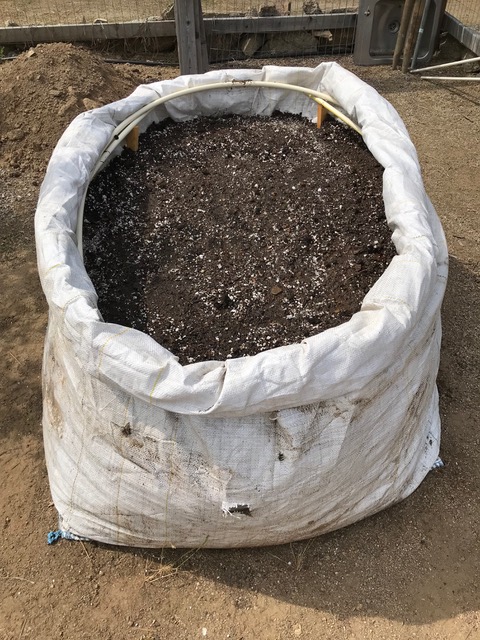
Club members Geoff and Dee Carson decided to try growing potatoes in a livestock feed mini-tote (holds 1000 pounds of feed), as their 2019 garden experiment. 


On 23 May 2019, Geoff planted 5 whole "Yukon Gold" seed potatoes (about 3" long), bought from "North 40", into a soil mixture of "Byar's Special Compost", then added about 15% perlite, and some granular organic fertilizer.  


Geoff added more compost as the plants grew up into the sunlight, and watered daily until 28 August 2019, as the cubic yard of soil drained really well.  Shortly thereafter, Geoff raised the heavy tote into the air with his beloved tractor, cut open the tote, and harvested 14 pounds of medium-sized potatoes.  

Geoff suspects the spuds would have been larger and heavier had he continued watering the plants for another month - maybe next year.  Nice job Carsons, and thanks for the photographic reportage:

jim


Sunday, September 8, 2019

Garden club meeting notice

We will be meeting at 7 p.m. this coming Tuesday evening (the 10th of September) inside Camden grange, for a fun and information-packed rendezvous.  Club member Marlene routt will be demonstrating how to make those cool concrete leaf planters, and we will have information on how to winterize your garden drip irrigation system, and we will discuss our annual Harvest Dinner, scheduled for next month.  The garden club will provide the main meat course for the meal, and I will have a dinner sign up sheet for those folks bringing the side dishes, desserts, and etc.

I've attached a picture of our (courtesy of Marlene - thank you!) concrete leaf - this is the "before" picture, as Pat has since filled the leaf with cactus mix soil, planted hens and chicks into the soil, and has entered into the "dish garden" competition at the Spokane Interstate Fair.

It is currently POURING rain outside - I cannot remember a wet August and September like we received this summer - I truly do appreciate the moisture.

jim

WEEDING BETWEEN THE LINES


By Jim McGinty


Lots to do in the garden – water everything, harvest, add compost or fertilizer, weed, replant or reseed the Autumn garden, plan for the 2020 garden – so much to do, and all with the thought In mind, that some time soon-ish, we will experience our first frost.  Ugh.

Daytime temperatures are still in the eighties Fahrenheit, so be sure to monitor the soil moisture levels in the garden, especially in your raised beds, as they dry out much faster than the soil in the open garden.  

If you are going to try an Autumn garden (to be harvested before the first killing frost – it says here in fine print), now is a good time to add compost or fertilizer to those beds or areas.  Even with an imposing deadline (and I do mean “dead” line) of first frost, there is time to plant or seed short season (forty-five day or less) somethings that will be edible:  baby carrots, cauliflower, kale, lettuce, bok choi, bunching onions, radishes, golden zucchini, turnips, bush beans, beets, and many more.  With a little effort on your part, and a long, warm lead-in to cold temperatures, you can potentially harvest a second crop of low-cost, high-quality food from your garden.

Above all else, now is a great time to closely look at your garden, with the intention of improving next year’s garden:  where will you rotate your 2020 crops, especially those susceptible to evil blight problems (potatoes, tomatoes, egg plants), or soil borne problems (garlic).  Which areas will need some fertilizer, and which areas will need a lot of fertilizer – we use an every other year light application of composted fertilizer approach here on Rancho McGinty.  Some gardeners use the four-year fertilizer approach:  heavily fertilize in year one (plant hungry crops like corn), no fertilizer for year two (plant squash and pumpkins), no fertilizer in year three (plant beans), and in year four, use the mostly-depleted soil for potatoes (helps reduce potatoe scab).  Then start over with a heavy application of poo.  

Right now is the time to trim back all those plant flowers.  Example:  we don’t have time for squash (actually there is NO time for squash – yuk) flowers to grow into mature fruit – you will have to decide if you want to remove all those precious flowers, and force the plants to focus on food production for you, or do you want to harvest a lot of immature, inedible (but I already used the word “yuk”) squash pods.Towards the end of September or in early October, it will be time to plant garlic:  I like to plant the individual cloves (pointy end up) in four inch deep trenches, six inches apart, with rows sixteen inches between (so I can carefully walk down the rows when weeding next Summer).  I rake the hilled dirt back onto the cloves, water heavily to settle the cloves, cover the area with six inches of mulch (to reduce weed competition and minimize over-Winter frost heaves), then walk away until next March.

If you have been wisely waiting until cooler weather, to plant new trees or bushes, the end of September is a good time for this chore – rainfall depending, you will want to provide lots of water to your new food factories.  With the recent underground rodent (gophers, moles, voles) invasion, I have started planting my precious heritage fruit trees in home made wire baskets:  I buy a three foot wide by ten foot long piece of galvanized half inch opening hardware cloth, and cut it into three equal-armed crosses (ala a Templar knight cross - a one foot square bottom, with four one foot square arms), bend the arms up at ninety degrees, and attach the arms together using wire, or zip ties.  I dig an appropriate hole in the orchard, drop the basket cube into the hole, add tree and dirt, and voila!  So far, three years into this concept, none of the new trees have been nibbled to death.

GARDEN CALENDAR


On September 10th, our local garden club will offer an indoor class on making concrete leaf castings – you have probably seen these giant (twenty-four inches wide, or more!) leaf-shaped casts, complete with leaf ribs and veins, used as planters, bowls, or bird baths.  We meet in Camden Grange at 7 P.M., and as always, the public is invited to attend.

For more details on the class, and for additional gardening information, you can check out our Facebook group page, or look at our club’s blogsite:  www.elk-camdengardenkeepers.blogspot.com.

On the 12th of September, those big-hearted boosters of bushy bounty, the Master Gardeners of Pend Oreille County will offer a class on backyard composting for the home gardener, taught by none other than my own self. The class will offer instructions, advice, and tips on creating your own “brown gold” from inexpensive or free ingredients, from 6:30 – 8:30 P.M., in the W.S.U./Pend Oreille County Extension office (227 South Garden Avenue, Newport).  Cost for the class is $5, and you can register for the class, or maybe ask additional questions, by calling the office at 509-447-2401.

That’s it for now – time to harvest the bush beans again, the sugar peas for the last time, and the fava beans for the first time – it’s great to be a gardener!

Tuesday, August 13, 2019

August tour warning

We will be assembling at Camden grange this coming Tuesday evening (13 August) for a tour of Vista Haven Farm.  We will depart Camden grange at 7 p.m. for the short drive to Kim McCay's farm, which features:  11 acres of hay fields, 1 1/2 acres of organic garden including a fruit orchard, asparagus beds, berry patch (blueberries, blackberries, raspberries, and strawberries), and cut flower raised beds.  Future farm improvements include 1/2 acre of baby vegetables and salad mixes, caterpillar tunnels, a large greenhouse, and high tunnels.

This will be our last tour of the summer, and you will want to bring along your cellphone (camera) and notebook/pencil, as Kim has a lot going on, and you will have a LOT of questions for her - she is very knowledgeable on the subject of small farms, u-pick operations, and gardening in general.

Next month, club member Marlene Routt has offered to show us how to make those amazing concrete rhubarb leaf garden decorations/planters.  Might be an outdoor class, might be indoors, depending on the weather.

See you Tuesday evening, 

Jim