Monday, July 11, 2016

Garden club tour warning – two, count 'em, two gardens!

We will depart Camden Grange at 7 p.m. on Tuesday, the 12th of July, for two garden destinations. One is an "industrial garden" right off Highway 2 just south of Newport, and another home garden and greenhouse at the south end of Diamond Lake. Be sure to convoy/carpool with us, or you will be lost/confused/irritated as you see the rest of the club members zoom past you, going the other way.

Bring your cameras – there is a lot to see.

jim

Sunday, June 26, 2016

Gardening education, 26 June 2016

A bunch of members from our gardening club attended today's class on "Winter Gardening: Growing through the snow," at the Priest River Event Center in Priest River, Idaho (5399 US Highway 2, Priest River).  The hour-and-a-half presentation was very thorough on how to build a "high tunnel" or hoop house (full construction details were provided), planning and planting the veggies, and tips on how to use the structure in minus temperatures during our challenging winter. Good class.

The next class offered at the Event Center is on 31 July 2016, from 2-4:30 p.m., on the topic of "Food Preservation and Canning," with hands-on instruction, recipes, and demonstrations on how to slash your food budget, how to plan ahead for harvesting, buying tasty, healthy food, and more.  The class is free, and more details are available at 509-631-2291, or online at TheReadyLife.com.

If you are going to the trouble of raising delicious, safe food, or if you are spending good money on the same, you really want to know how to preserve that food. Jus' sayin'.

jim

Saturday, June 25, 2016

Water storage

While touring the amazing garden of club members Marlene and Steve, many club folks asked about their rooftop rain catchment systems, and the storage cubes used to hold about 250-300 gallons per cube of precious garden water.


A source for the cubes: call Chris at 208-755-1522. Chris stores his cubes at the Spokane Industrial Park, out in the Spokane Valley, and recently charged $30 apiece, but will negotiate for multiples.

Most of the cubes held light machine oil (some are castor oil-based), but you will want to check each cube's label as I'm sure some of the cube contents will NOT be good for people or their food.

jim

Friday, June 24, 2016

Weeding between the lines

By Jim McGinty

Thunderstorms, hail, heavy rain, 100-degree-Fahrenheit heat, and high winds are making gardening in Northeast Washington very challenging this summer.  

Here at Rancho McGinty, our cool weather crops (kale, chard, sugar peas, etc.) are all hanging on much longer than in previous hot summers, due to our constantly changing weather. Our traditional hot weather crops (tomatoes, peppers, livestock squash, etc.) are hanging in there as well, probably on the rumors of imminent long, hot days, and warm overnight temperatures. I think the plants and the humans are all a mite confused, but making the best of it.

Out in the garden, the garlic crop looks really good, with the plant tops already curling and producing edible flower pods (called “scapes”). 

Our strawberry bed is literally overflowing with ripe, red (inside and out – none of those nasty white California strawberry interiors!) fruit, while the vining blackberry plants and their flowers are very popular with the local honeybees.  

In the orchard, the news is from the “good news, bad news” category, with apples and pears hanging from young trees (that’s the good part), and (here’s the bad part) gopher-killed trees that looked SO healthy in early spring. Thus far, the gopher ingrates have de-rooted and killed two apple trees, and have nibbled on two others – the jury is still out on whether or not the trees will survive. Speaking of “survival”, I have taken a whole new, and politically-incorrect, approach to the whole “sympathetic to nature, go-along-to-get-along, kumbayah-singing, rodent respect” mindset: I now look daily for fresh gopher sign (kinda sounds like a mighty hunter, only in miniature), and when I find their mounds and holes, I roll two stinky mothballs into those dark dens of apple-decimating depravity, and cover same with dirt. So far, the fumes from said mothballs seem to have turned the course (literally) of the incisored invaders, as their new mounds are currently on a track to open fields of grass and weeds – may their OSHA-approved hardhats fail them!

In the garden, now is the time to carefully check daily for moisture needs around the plants, especially in your raised beds: I use my Mark One (Mk. 1) Finger Probe to see if the soil is muddy, moist, or dry, an inch or so below the surface. Watering is best accomplished in the early morning now, and inexpensive water timers are your friend – attach one to your hose bib, set the timer, and sleep in late.

This is the time of maximum plant growth and bud/fruit/veggie production, so be sure to apply liquid nourishment to limp or challenged-looking (yellow leaves, sickly appearance) plants: liquid kelp, fish fertilizer, or manure tea will help.

If you are planning to garden in the second, autumn season, now is the time to start those cool weather plants for mid-August transplanting – there is no sense in letting that sweat-equity dirt lie fallow until next spring!

If you have finished harvesting your June-bearing strawberries (berries produced in one big flush, in June, hence the name), now is the time to fertilize the plants, BUT if you are raising everbearing strawberries (berries produced throughout the summer), then you want to wait until half way (mid-August?) through the season.
Oh, and pull all those weeds (snicker, snicker).

GARDEN CALENDAR

I’ll be teaching a slug (no pun intended) of gardening-related classes in July at the Newport College Center (1204 W. Fifth St., Newport).  You can register for any (or all) of these classes by calling 800-845-3324, or you can register on-line at www.sccel.spokane.edu/ACT2.

“Drip Irrigation in the Home Garden” will show you how to set up your own time and labor-saving irrigation system (tools, supplies, and techniques will be discussed in depth).  Class date is 6 July, from 6-8 p.m.

“Herb and Kitchen Gardens” will discuss how to grow delicious herbs from seeds and propagation; we’ll also discuss how to harvest and store those tasty leaves and seeds. Class date is 13 July, from 6-8 p.m.

“Raised Bed Gardening” will show you how to design and construct raised garden beds that will help you get a head start on spring planting and extend your garden season. Class date is 20 July, from 6-8 p.m.

On July 12, our local gardening club will be touring two (count them – two!) local gardens: first, we will visit a garden built from repurposed industrial materials (ore tubs, steel conduit, fiberglass roofing), and then we will visit a home garden featuring raised beds, compost production area, small fruit orchard, and a really cool homebuilt greenhouse. We’ll be departing Camden Grange at 7 p.m., and convoying north on Highway 2 for this tour, so don’t be late!

That’s it for now – time to decimate (not just one in 10, but all!) those weeds in the potato bed – maybe I can train the gophers to appreciate the taste of weeds??!

June garden tour - yowsa!

Jim, Marlene and Steve. Marlene holds the coveted (or maybe not) garden-club gnome,
presented to all tour hosts. In the background, the garden gates slide horizontally
on pipe rails, a typical touch in this well-organized and clever garden.


Our garden club toured an amazing garden in June - club members Marlene and Steve are the garden's operators and/or weed slaves, and we had a great time!  


Marlene and Steve graciously answered about 200 questions (some redundant questions, there), and provided us with delicious homemade snacks as well.  

Steve's rooftop rain catchment system was a huge hit, and more than a few garden folk are now planning something similar, as we are all a little concerned about rain late in the summer.   

Even the composting area is neat and well-designed.

Marlene's compost production area also prompted some of our gardeners to plan better, more efficient systems, and their home built greenhouse was closely inspected by nearly every garden tourist - I watched a couple of energetic gardeners sketching and noting how Steve built the structure, and how Marlene uses the greenhouse to add time to our local far-too-short growing season.


Club members explore rows of raspberries, rhubarb and fruit trees. Note the water lines at each tree.


Thanks again to Marlene and Steve!

Wednesday, June 1, 2016

Custom squash trellises

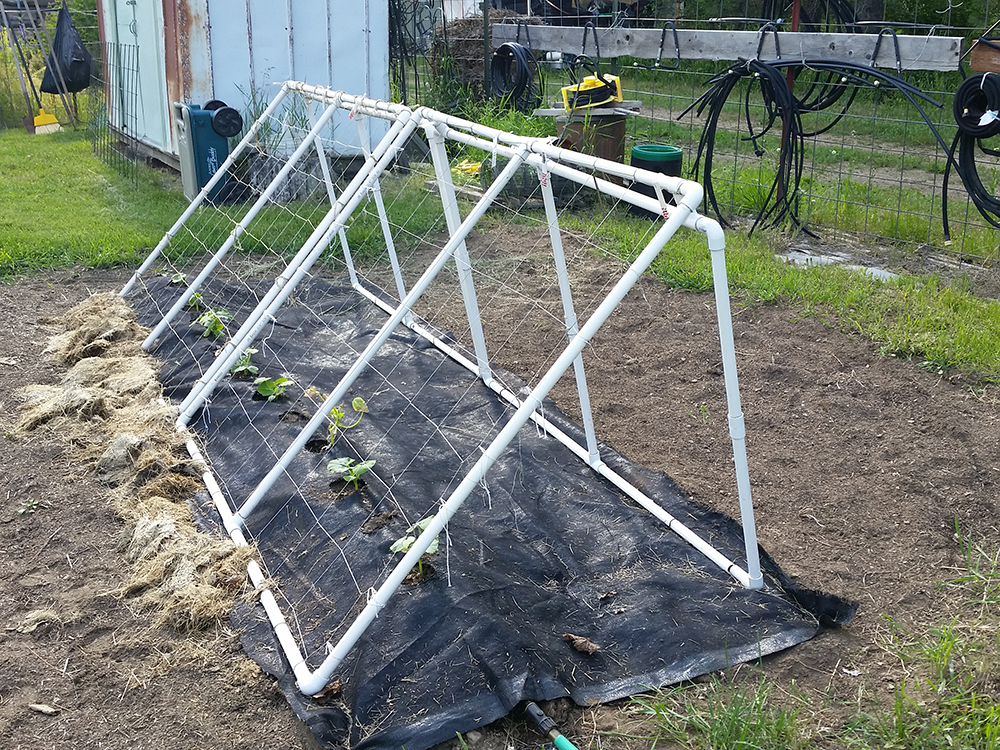
In my June gardening column, I mentioned that I am trying a new piece of homemade equipment in the garden, this year. The squash trellises were built by my gardening partner, Pat, from ¾-inch Schedule 40 PVC pipe and fittings. I have attached three photos to show the fronts, backs, and one side of one of the trellises.

The front of the trellises, with netting to train the vines up.

To use the trellises, I first built up a raised mound the length of the two trellises in which to place the squash and pumpkin plants (I used chicken house shovelings – manure, wood chips, dirt – squash and pumpkins need a LOT of nitrogen and food), then I placed a weep hose (black drip-irrigation hose) along the length of the mound where the plants would benefit, and covered the mound with weed fabric, over an area the size of the two trellises with their legs extended. I borrowed an idea from club member Bill Turner, and used a propane torch to burn 3-inch diameter holes in the weed fabric (thanks Bill, that worked great, and the heat sealed the edges of the holes so I have no tear-out) on the top of the mound, and about 12 inches apart –  I then planted the squash and pumpkins into the holes. I plopped both trellises over the plants (being vewwy, vewwy careful!), and that was about it – the fronts of the trellises have nylon netting (5¼-inch square openings – we bought ours at Bi-Mart in Deer Park – remember to use your club membership card for a 10-percent discount!) tied into place, and I plan to train the vine tendrils up the netting as they develop. 

The back of the trellises, with access to the plants.

You can see the drip hose heading for the plants under the weed-blocker fabric.
When the actual squash and pumpkins show up, I'll support them UNDER the netting using panty hose (no, not mine) or some such – the plan says I can harvest the chicken food sometime this autumn, and still have a LOT more flat garden real estate, since the squash and pumpkins plants will be growing more or less vertically. 

I'll let you know how this turns out - I'm also growing kale and chard for the chickens as well, and maybe even the goats and sheep will appreciate the greens.


jim

Wednesday, May 25, 2016

Weeding between the lines

By Jim McGinty

It’s hard to say where we are, weather-wise:  it’s early June now, but we’re still receiving rain like it’s April, BUT daytime temperatures are in the upper 70s Fahrenheit, sort of like early July. Tough adjustments for the garden plants, and tough on us humans as well – the plants AND the people have to ask “do we wear tee-shirts or flannel shirts, and do we bring an umbrella??!!”  Welcome to the “New Normal.”

Out in the garden, here at Rancho McGinty, the garlic stalks are waist high and dark, dark green – might just be the best garlic harvest, ever. The potato plants are up and growing, and the Colorado potato beetles have discovered them as well, so I’m spraying Neem oil every three days or so. The onion and shallot crops are trying desperately to catch up with their garlic cousins, and the sugar peas are twining their way up the bird-netting trellis – no sign of pea flowers, yet. I’m growing the livestock squash on a PVC pipe frame this year as an experiment – my gardening partner Pat built a reclining pipe frame and support leg, which will allow me to bring the climbing vines up through the netting (five and a quarter inch square openings), so they can climb up the angled frame – I’ll have to support any chicken squash using nylon mesh or somesuch, as they hang down under the frame. Both the kale and the chard plants are looking small but viable,  and the broccoli is just loving this weather – steamed broccoli soon!

Next to plant will be the tomatoes and peppers – most of them will be planted in the “Earth boxes” on the front deck, but a bunch of them will be planted in the open garden, in raised beds. Also the bean crop will seeded next to its trellis, and the cabbage will be finally big enough to transplant into the soil – I cover the cabbage rows from planting to harvest with floating row cover (Ree-May, bought locally from Northwest Seed and Pet, in Spokane) to keep all those pesky white “butterflies” from laying their cabbage worm eggs in my precious plants.

This has been an especially fragrant spring for tree flowers, just in case you have not wandered past a tree in bloom:  the apple, pear, and cherry blossoms were prolific and wonderfully stinky. Even our maple trees and choke cherry bushes were detectable across the street, and our good friend Annie gave us a bouquet of flowers from her black locust tree – amazingly nice aromas.

When our summer heat and dry weather do arrive (soon?), we’ll want to take some steps to reduce the heat trauma to our plants, and we’ll also want to reduce any (expensive) water wastage in the garden:  three to four inches of mulch (tree leaves, grass clippings, pine needles) around each plant, add compost or shredded tree leaves to each transplant as they go into the garden soil, check for soil moisture using your Mark I Finger Probe, water in the morning (battery-powered garden hose timers are inexpensive, and allow you to sleep in late!), use drip irrigation to apply water directly to the plant, and pull all those competing weeds.  Speaking of water, remember to find and drain any mosquito-breeding puddles:  check those kiddie pools, empty trash cans and buckets, stacked snow tyres, etc.

Out in your garden, it’s probably (?!) safe to transplant all those sensitive plants (tomatoes, peppers, etc.), and this is a good time to seed beans, corn, livestock squash and pumpkins, beets, carrots, and lettuce.

In the orchard, remember to thin those baby fruit to about six inches apart, and zealously prune out all those epicormic (water) sprouts – they just use up your tree’s energy.

GARDEN CALENDAR

On June 9, those vegetation venerators of the Pend Oreille County Master Gardeners will host a class on garden drip irrigation systems from 6-8:30 p.m. at the WSU/Pend Oreille County Extension Office (227 S. Garden Avenue, Newport). You can call the office at 509-447-2401 for details or to register for the class.

On June 14, our neighborhood gardening club will be touring a local garden with LOTS of really cool features:  raised beds, berry patches, roof-top rain collectors, solar lighting, cold frames, and more.  We’ll depart Camden Grange at 7 p.m., and as always, the public is invited – oh, and be sure to check our club internet blog site, right here, for updates and the latest garden gossip.

Finally, I will be teaching a series of gardening classes in June, in two locations:  Corbin Senior Center (827 W. Cleveland Ave., Spokane) from 2-4 p.m., and at the Newport College Center (1204 W. 5th St., Newport) from 6-8 p.m.
The classes and class dates are as follows:

  • “Renovating Old Apple Trees” will cover the pruning process necessary to bring an abandoned apple tree back into production (June 4 at Corbin, June 15 at Newport).
  • “Herb and Kitchen Gardens” will discuss (and taste!) fresh herbs grown from seeds or by propagation, in your back yard (June 11 at Corbin).
  • “Raised Bed Gardening” will discuss the benefits of building and using raised beds in your garden (June 18 at Corbin).
  • “Drip Irrigation in the Home Garden” will help you to save money, grow healthier plants, and conserve water and energy (June 25 at Corbin).
Classes cost $14 each, and you can register for the classes by calling 509-279-6030, or going online at www.sccel.spokane.edu/ACT2.

Whew – that’s enough – I need to go outside and mow some waist-high grass, and knock back some of those lush weeds.  Sounds tiring, huh?